
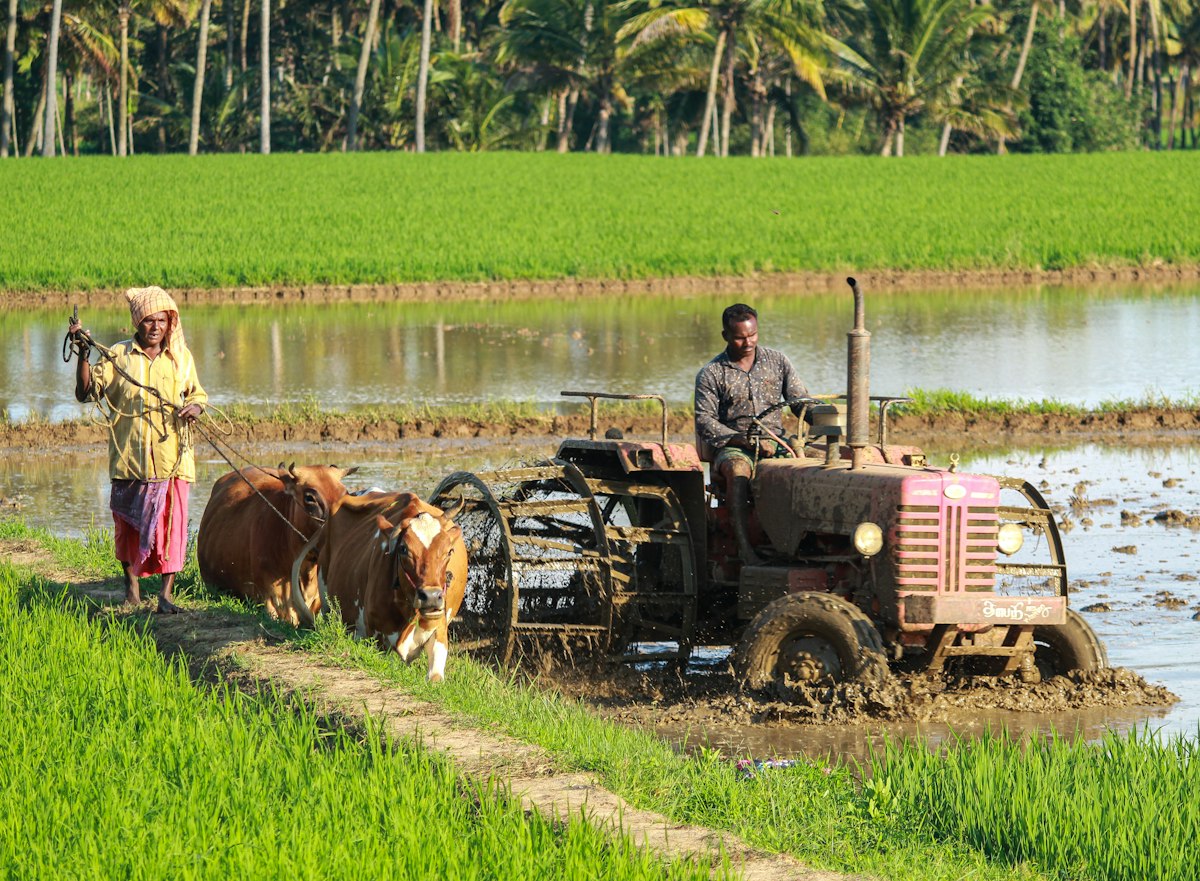
In February, Nigeria’s federal government launched the deployment of 2,000 tractors, 10 combine harvesters, 12 mobile workshops, and 9,000 implements, a flagship of Abuja’s food sovereignty agenda. The hardware had sat in storage for roughly seven months after arriving from Belarus in mid-2025 [TheCable, February 2026]. Two months later, the Sasakawa Africa Association used its Kano summit and its 40th anniversary stakeholders’ workshop in Abuja to argue that the binding constraint on African mechanisation is not the tractor count, it is the operating model behind it [Sasakawa Africa Association, April 2026].
This is the right argument at the right moment. Nigeria’s mechanisation gap stands at below 0.3 horsepower per hectare, a fraction of the levels seen in even modestly mechanised economies, and the past two decades of state-led procurement schemes have produced little durable change [MSME Africa, April 2026].
The pattern that keeps repeating
The story is well-rehearsed. A government procures iron, often via concessional financing or a bilateral credit line; tractors are distributed through a state agency or political networks; spare parts and trained operators do not follow; service revenue is opaque; and within 18 to 36 months the fleet is broken, idle, or functionally privatised by whoever held the keys. The Belarus Project is the latest installment, its first phase will deploy 600 of the 2,000 units, with each tractor expected to service around 600 hectares per year, and a programme target of 1.2 million farmers across 1.5 million hectares [Nairametrics, February 2026]. Whether those numbers survive contact with the bush depends almost entirely on what is built around the machines.
The Sasakawa proposal in Kano reframes the question. Three Agricultural Mechanisation Centres established under the Kano State Agropastoral Development Project are being repositioned as pilot platforms for a commercially viable service model: competitively selected Managed Service Providers run day-to-day operations, the state provides policy oversight rather than running fleets, and revenue is protected through digital payments, transparent cost-recovery, and preventive maintenance schedules. Smallholder access is preserved through a structured, time-bound subsidy of 10 to 20 percent of market rates, weighted toward women, youth, and cooperatives [SolaceBase, April 2026].
The wider continental signal is consistent. The African Development Bank’s Special Agro-Industrial Processing Zones (SAPZ) programme, which the OPEC Fund and TDB Group joined as Alliance members earlier this year, has now committed roughly USD 934 million across more than two dozen zones in eleven countries, and crowded in another USD 938 million from co-financiers [AfDB, January 2026]. SAPZ and the Sasakawa AMC model are adjacent answers to the same question: how to package the public balance sheet, the multilateral concessional pool, and private operating capability into something that actually clears markets at the farm gate.
Pamoja Insights
First, the unit of analysis is the service contract, not the tractor. A tractor without a maintenance regime, an operator pipeline, a parts supply chain, and a digital revenue rail is a depreciating gift, not an asset. Investors and DFIs underwriting mechanisation should structure exposure around service-level KPIs, utilisation hours, mean time to repair, collection rates, rather than asset count. This is the same shift the power and water sectors made fifteen years ago, when iron in the ground gave way to availability-based PPPs.
Second, Nigeria’s seven-month delay between tractor delivery and deployment is the most important data point in the Belarus Project. It is not an administrative footnote; it is a signal that the binding constraint is institutional, not capital. Markets that price the deployment as fait accompli are likely to be wrong about timelines and impact in either direction. The same risk applies to the Tanzania National Agricultural Mechanisation Strategy 2026 to 2036 and to any successor programmes that adopt the Kano playbook without adopting its governance.
Third, the replicability premium sits with the operator, not the policy. If Sasakawa’s AMC framework works in Kano, the scarce factor across the continent will be qualified Managed Service Providers, local engineering and logistics platforms with the ability to run distributed asset fleets to commercial standards. Equity capital backing those platforms today buys exposure to a pipeline that ten governments will need over the next decade.
Fourth, PPP is the right structure, but only if the risk allocation is honest. The historical failure mode in African mechanisation PPPs has been the public side retaining tariff and counterparty risk while the private side carried operational risk on subsidised pricing. Bankable structures will need viability gap funding, foreign-exchange hedging on imported parts, and explicit fiscal commitment letters, not just a brand on a press release. The SAPZ Alliance’s expansion to include the OPEC Fund and TDB suggests a quiet recognition that the missing piece is concessional liquidity at the project-preparation stage, not announcement-level capital.
Fifth, watch the second-order food security trade. If mechanisation in Nigeria, Ethiopia, and Tanzania moves from announcement to throughput, the medium-term implication is a structural reduction in import dependency on staples, which prices into fertiliser demand, regional logistics, and the case for African agro-processing capacity. The market is currently treating those linkages as cyclical, driven by FX and weather. In our view, the structural driver is mechanisation throughput, and that is being underpriced.
The bottom line
The next round of African mechanisation deals will not be won by whoever ships the most tractors. It will be won by whoever can keep them running at 70 percent utilisation for ten years.
Sources
- MSME Africa, April 2026 — msmeafricaonline.com
- SolaceBase, April 2026 — solacebase.com
- TheCable, February 2026 — thecable.ng
- Nairametrics, February 2026 — nairametrics.com
- African Development Bank, January 2026 — afdb.org
- Sasakawa Africa Association, April 2026 — saa-safe.org